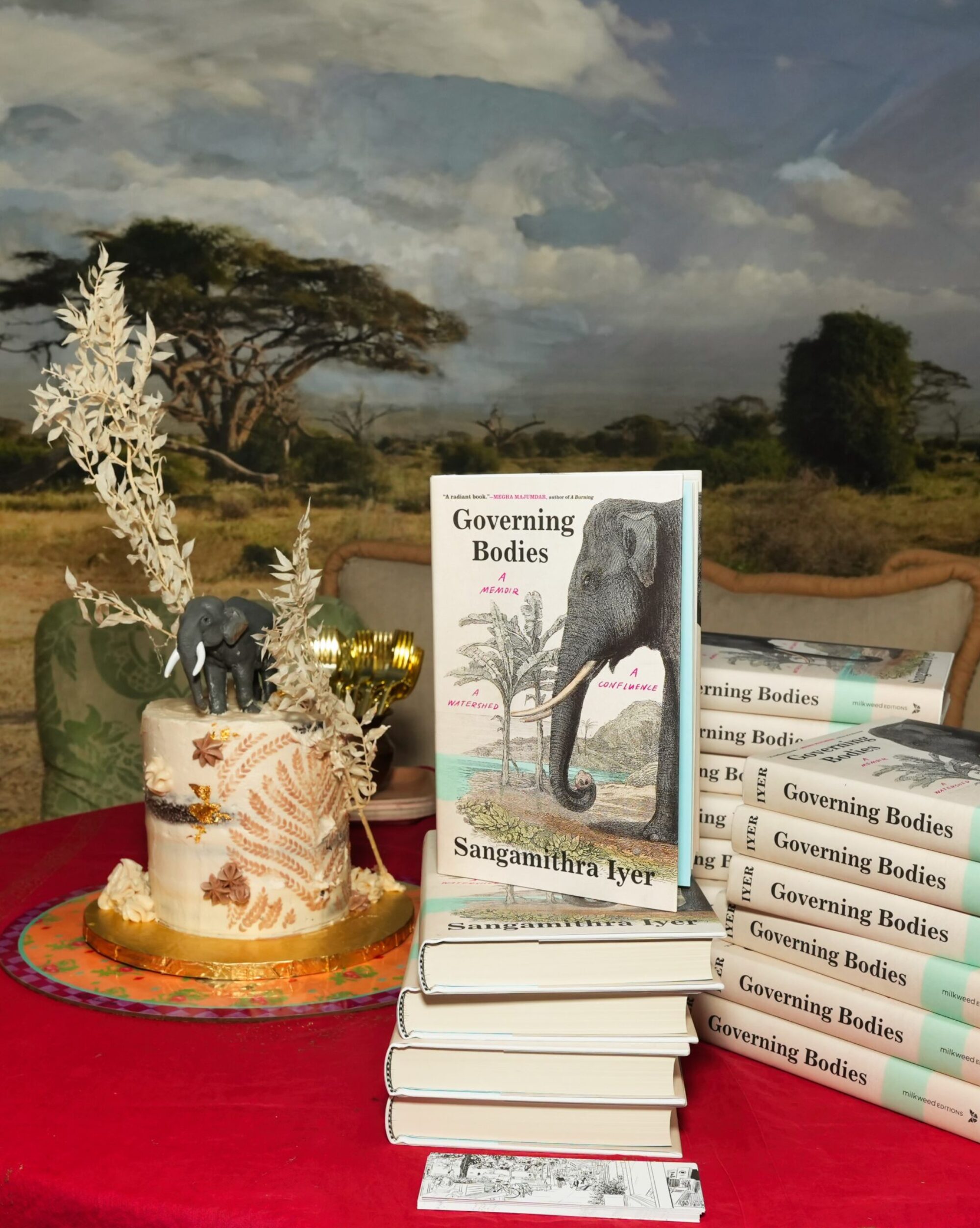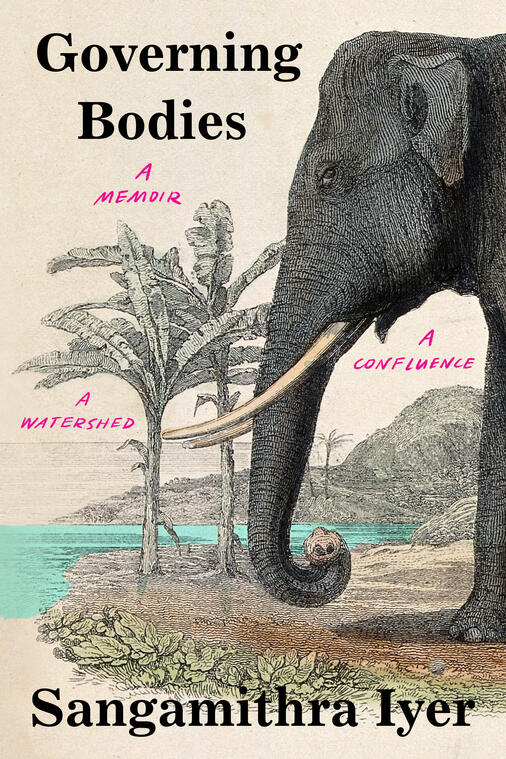
Winner of the 2026 Firecracker Award for Creative Nonfiction, Recipient of a Whiting Creative Nonfiction Grant, A Diamonstein-Spielvogel Fellowship at the New York Public Library, a Cafe-Royal Grant, and Jerome Foundation Travel/Study grant for Literature.
Praise for Governing Bodies:
[An] evocative and whip-smart memoir . . . Governing Bodies provides a crucial voice in a time of increasing peril.”—Booklist, starred review
“Iyer traces her passion for conservation and animal rights activism back two generations in this beautiful debut memoir. . . .This singular personal history edifies as much as it charms.”—
Publishers Weekly
“VERDICT Highly recommended for readers seeking excellence in creative writing.”—
Library Journal
“Governing Bodies: A Memoir, A Confluence, A Watershed weaves together research and personal narrative in a genre-blurring work that is both a memoir and an argument. Within it, Sangamithra Iyer builds bridges between the different aspects of her identity, between humans and animals, between the past and the present. She writes to seek truth and reckon with grief. Iyer challenges us to have more compassion and empathy/sympathy for all living things, to think in a thoughtless world, and to feel when the world tries to numb us. The book is indeed a confluence, and one that offers a model to other writers who live intersectional lives and write intersectional stories that hold both the personal and the political. Governing Bodies is a stunning book, both in content as well as form, with a cover and table of contents whose designs are just as thoughtful as the words within.” —from the judges of The Firecracker Award in Creative Nonfiction.
“Sangamithra Iyer writes with the kind of intelligence and attention that makes you lean in, asking how we might live in this aching world with more care, more kinship, and more courage. Governing Bodies beautifully guides us with the lyrical grace of someone who knows the liberation and legacy of what magic can happen when you combine the language of water and the weight of memory.”—Aimee Nezhukumatathil, author of World of Wonders.
” It’s a remarkable book that blends the modes of memoir, journalism, essay, and cultural commentary with the lyrical sweep and rhythm of poetry to paint a vivid picture of both the natural world and the life of a family.”—Kazim Ali, author of Northern Light
“Governing Bodies encourages us to love generously and attentively all that thrives in the world—primates and hens, rivers and soil—and to heed the continuity between human and planetary bodies. A radiant book of reflections that will stay with me.”—Megha Majumdar, author of A Guardian and a Thief
“Through memory, research, imagination, and profound love for the human and more than human world, Sangamithra Iyer has not so much written a book as created a utopia inside its pages. Governing Bodies is the work of a mind as agile as water, with many surprising streams feeding into the shining whole. This book does what the best books do: It helps me live.”—Shruti Swamy, author of The Archer
“This project brims with loveliness; Iyer writes about family and ecology and the legacy of colonialism with enduring insight and gentle, heartbreaking passion. She delivers a subtle, meditative exploration on grief and nonviolence, an international and intergenerational voyage through shared histories and a consideration of what we owe to each other and the natural world.”—Whiting Creative Nonfiction Grant jury
INTERVIEWS
“SANGAMITHRA IYER’S DEBUT memoir, Governing Bodies (2025), is structured like a watershed. Wide-ranging, poetic, and composed over a couple of decades, the narrative is enriched by time, reflection, and many divergent streams of thought, weaving connections between ecological and familial loss, legacies of compassion and activism, and Iyer’s own work as a civil engineer and advocate for animal liberation. The memoir coalesces around her vision of protecting vulnerable species and waterways.”- Parul Kapur
“I consider this a gift of a book in many ways. I have been working for many years at the intersection of art, science, and creativity. Your book is a gift to those of us who are seeking a new path, a new way to live, a new way forward— something that, for whatever reason, does not fit the status quo, the norms, the monopolies, the singleton ways, the specialization, the professionalization of everything. And at that confluence is art and science. We certainly do not want to give up science and reason, and we do not want to give up what art is to us and what it represents in our world as humans. And so, this book is a gift because there are not many people writing at this confluence. Because it is really a difficult thing to do”- Madhur Anand (Photo below by Gia McKenna)

“When I tell you a story about my body, I cannot separate it from a story about water. And a story about water is also a story about family. And a story about family is rooted in the earth…,” opens Sangamithra Iyer’s Governing Bodies. What does it mean for a memoir to assume the elusive, ever-changing shape of water, to be the story of family but where the notion of family crosses the boundaries of blood, culture, nation and even species? Governing Bodies, as the Whiting judges said in their citation, is “a subtle, meditative exploration on grief and nonviolence, an international and intergenerational voyage through shared histories and a consideration of what we owe to each other and the natural world.”
While vegans share a belief in a way of life that excludes—as far as is possible and practicable—all forms of animal exploitation and cruelty, I learn from these interviews that every author writes with a unique perspective, and no book reads like any other. Governing Bodies by Sangamithra Iyeris an exceptional example of what I mean. It’s a rare book offering insight within and beyond how we ordinarily understand what it means to live as a vegan. The intriguing subtitle, A Memoir, A Confluence, A Watershed, shows us why.
Elise Myslinkski interviewed me for this wonderful discussion about memoir and writing for animals.
“The first time I heard of Sangamithra Iyer, I knew she was one of my people. The way she talks of writing, of animals, and of the power of literature to change the way people think about animals speaks directly to my soul.”
Q&A with my publisher
PICKS
“In her Whiting Award-winning memoir, civil engineer and immigrants’ daughter Sangamithra Iyer offers a subtle but passionate exploration into family, ecology, personal and planetary grief, and the legacies of colonialism, capitalism, and speciesism. In braiding the story of her freedom-fighting grandfather with her own experiences as an activist and engineer, Iyer meanders, like a river, with purpose and grace.”
“This memoir resonates on historical, ecological, and deeply human frequencies. Iyer writes at the intersection of ethics, ecology, and ancestry, and what emerges is not simply a book but a living organism of narrative.”
REVIEWS
Full Stop Magazine has this thoughtful review by Samara Skolnik who treated my work with such care.
“One of the book’s strengths is how it carefully recounts exposure to ideas that accumulate into belief and eventually into action”
“..it is clear that Iyer is not in the business of using animals to serve human needs, even on the page. Instead, she is equating the oppression of animal bodies to the oppression of human ones. We are not the only ones who feel, or who desire to be free. Iyer, in her sprawling consideration of her experiences and influences, urges us to believe that if there is something singular about us, it is not so much that we are human, but that we can choose to be humane.”
“If I were to use one word to describe Governing Bodies: A Memoir, a Confluence, a Watershed (Milkweed Editions, November 2025), it would be tender. Tender as the eyes that witness suffering. Tender as the body that must bear the burden of suffering. Tender as the soul that attempts to alchemize what the eyes see and body know into a kindness we can live by.”
“Lovingly researched and beautifully written, with wit, compassion, and reverence for animals and our environments,
Governing Bodies is a riveting and inspiring book for anyone who hopes to connect more deeply with the world we share with so many other beings.”
FoodPrint reviewed
Governing Bodies in “What if we imagined the fates of humans and animals as interconnected?” by Alicia Kennedy
For publicity and media inquiries please contact my publicist